Active vs. Passive Packaging in Cold Chain Logistics: Which is Right for Your Temperature-Sensitive Cargo?
Introduction: The Choice Between Control and Risk
For any supply chain manager dealing with temperature-sensitive goods, ensuring product efficacy is the top priority. The central challenge in cold chain packaging is: how do you maintain a stable temperature in an uncertain transport environment?
In the Cold supply chain, two main solutions exist: Passive Packaging and Active Refrigeration Containers. Distinguishing between these two is critical, as it determines whether your cargo is merely insulated (Passive) or is receiving continuous cooling/heating (Active).
This article will compare the performance, cost, and suitability of these two Cold chain packaging strategies to help you make the right choice for your Temperature controlled logistics.
z
The Passive Packaging Solution: When is it Sufficient?
Passive packaging represents the traditional cold chain solution, primarily used for short-duration or lower-risk shipments.
Composition and Mechanism
Passive packaging (such as cool chain packaging or passive packaging for pharma) relies on:
Insulation: Materials like expanded polystyrene foam (EPS), vacuum insulated panels, or polyurethane foam.
Refrigerants: Such as water-based ice packs, gel packs, or dry ice, used to absorb heat and release cold energy.
Advantages and Limitations
Passive solutions are typically lighter and cheaper, but their critical flaw is limited duration and inability to react to environmental changes.
The Pain Point: The temperature inside the packaging is unidirectional—it only drifts over time. If the external temperature is too high or if the shipment faces delays, the cargo is highly susceptible to temperature excursions and subsequent loss.
Applicable Scenarios: Only suitable for short-duration Cold chain delivery where transport time is controlled and the external environment is relatively stable.
Active Solutions: Unmatched Control and Reliability
Active temperature control systems—such as your
Cold Chain Refrigeration Container—feature integrated mechanical refrigeration technology designed to maintain a precise temperature continuously, regardless of external conditions.
The Technology Behind Active Cooling
Active systems ensure that the temperature can be adjusted in real-time, rather than merely being delayed.
Active Cooling Core: Integrates an Internal Refrigeration Unit comprising an efficient compressor and evaporator. It utilizes advanced technology to rapidly lower and maintain a stable low-temperature environment, enhancing cooling efficiency.
Modular and Maintainable: The refrigeration unit is designed to be detachable and separable from the main cabinet, facilitating easy maintenance, cleaning, and replacement, thus improving the product’s flexibility and operability.
Wide Applicability: Active technology reliably covers the standard cold chain temperature range (+2°C to +8°C) and, with specific configurations, can meet Ultra cold chain requirements (e.g., below -60℃).
Critical Advantages in Global Cold Chain
In complex Global cold chain logistics, active temperature control is the only reliable choice for high-value cargo and biologics.
Constant Control: The system can automatically regulate temperature and humidity based on internal environmental changes, ensuring the cargo remains in optimal transport conditions without manual intervention.
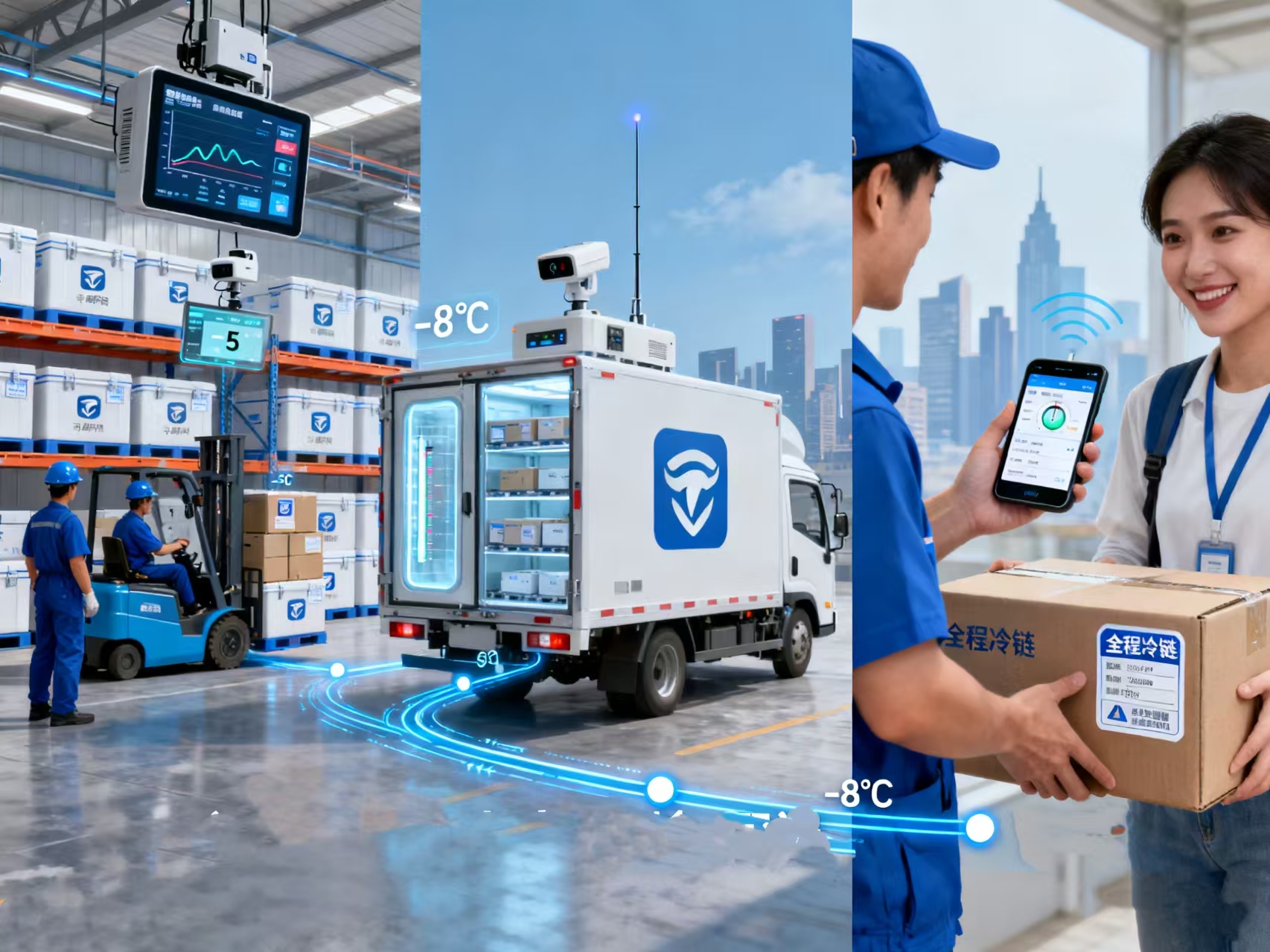
Real-time Remote Monitoring: Intelligent monitoring and self-control functions allow users to remotely control the unit's settings (temperature, power) via a mobile app or PC, enabling full monitoring and management of the cold chain logistics monitoring process.
Risk Alert System: When the temperature or humidity exceeds the set range, the system automatically issues an alarm, allowing for prompt intervention to prevent cargo loss and shipping delays.
High Reliability: The product features both Refrigeration and Cold Storage Functions. The cold storage function ensures that cold energy is continuously released even during a power outage, protecting the cargo.
Your choice depends on the distance, the value of the cargo, and the required level of temperature compliance.
| Feature | Passive Packaging | Active Container (Our Container) | Decision Factor |
| Control Mechanism | Relies on refrigerants for insulation only | Mechanical cooling/heating, actively regulates | Stability |
| Temperature Range | Narrow, susceptible to external drift | Broad and precise (covers all cold chain temperature zones) | Adaptability |
| Duration | 24 - 96 hours | Days to weeks (power dependent) | Transport Distance |
| Monitoring | Local data logger only | Real-time remote monitoring & alarms | Compliance & Risk |
| Maintenance | Single or limited reuse; requires pre-conditioning | Long service life, modular design for easy maintenance | Total Cost of Ownership (TCO) |
Investing in your Cold chain refrigeration container is advisable if your operations meet any of these criteria:
High-Value Cargo: Transporting expensive biologics, clinical trial samples, or temperature-sensitive pharmaceutical cold chain packaging.
Long Duration: Involving international or intercontinental Cold chain shipping that exceeds 96 hours.
Strict Compliance: Requires precise temperature data and Cold chain logistics monitoring reports.
Operational Efficiency: Your product features a flexible adaptation design, easily integrating with various transport tools without vehicle modifications.
The Future of Cold Chain: Reliability Through Active Technology
The future of the cold chain increasingly relies on the reliability and sustainability driven by Coldchain technology. Your product, with its Energy-Saving Design and use of Eco-friendly Materials, not only secures cargo but also aligns with the global push for Sustainable cold chain packaging.
Active solutions inherently contribute to sustainability by significantly reducing cargo loss, thereby lowering operational risk and cost. For clients seeking reliable Cold chain solutions companies, integrated active temperature control is the definitive factor in safeguarding product quality.
Conclusion
When dealing with high-value pharmaceuticals or complex Global cold chain logistics, compromising on temperature control is not an option. Active refrigeration containers provide a level of security, precision, and remote management that passive packaging simply cannot match.
Upgrade your transport strategy. Contact our experts today to learn how our Active Cold Chain Refrigeration Containers can guarantee safety and compliance for your most sensitive shipments, and reduce your long-term operational costs.
Mobile Phone :+86 15890051653
Email :melissa@newbasen.com
Website :https://www.newbasecool.com


 z
z


