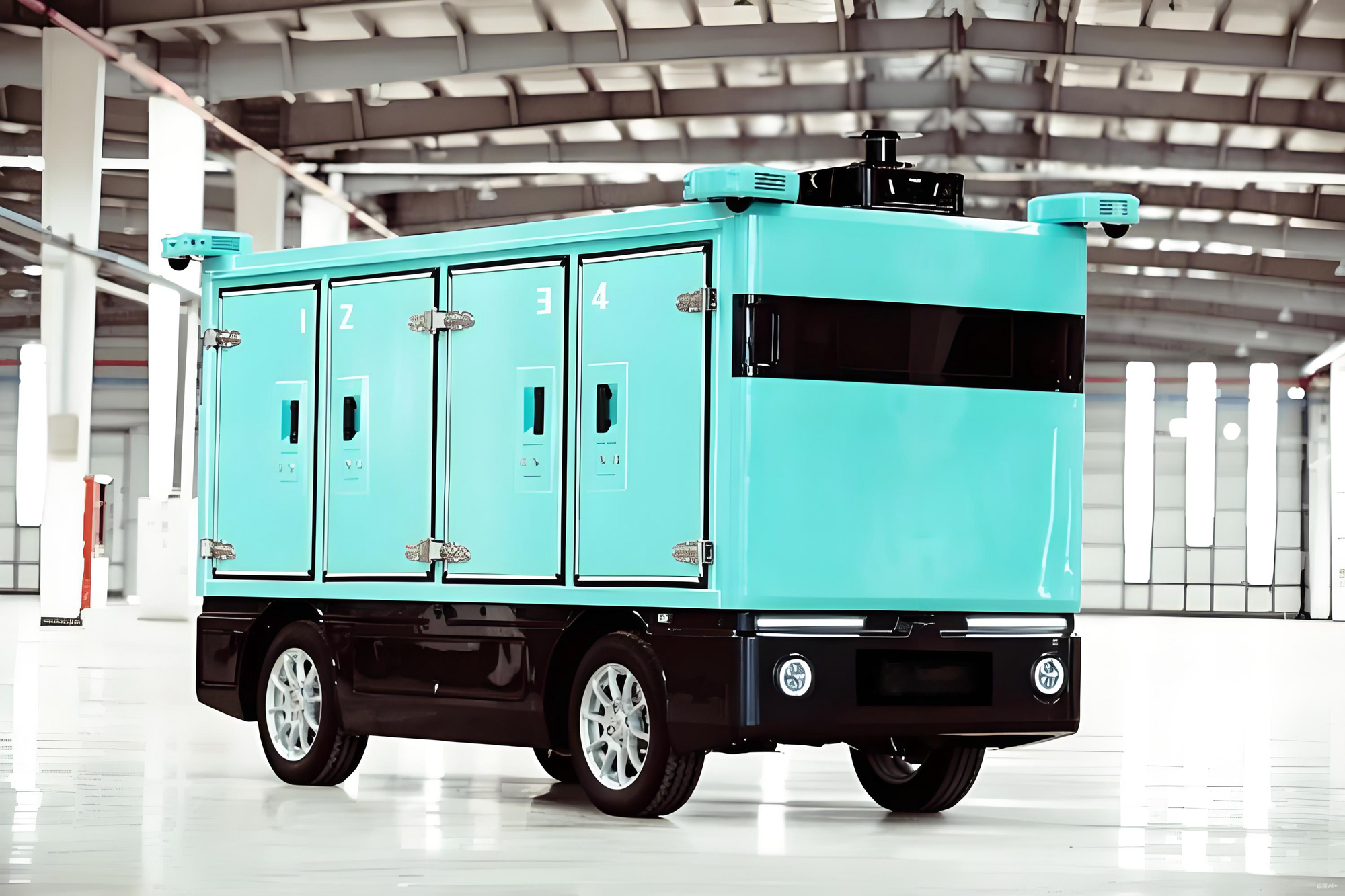
Whenever a client stands in front of our
Autonomous Logistics Vehicle, the most frequent question is: "How does it drive more steadily than a human without a driver?"
As someone driven by technology, I like to compare this vehicle to a "mobile precision brain." Today, I want to take you under the hood to uncover the operational logic of L4 Autonomous Technology in the logistics sector.
What is True Level 4 Autonomy?
In logistics, Level 4 (High Automation) means the vehicle can complete all driving tasks from point A to point B within specific urban or campus environments without any human intervention. To achieve this, the vehicle must master four core capabilities: Perception, Positioning, Decision-making, and Execution.
1. Deep Perception: Multi-sensor Fusion Logistics
A single sensor always has limitations. That is why we employ a Multi-sensor Fusion Logistics approach:
LiDAR: The laser radar at the front is the vehicle's "primary eye," scanning the surroundings millions of times per second to generate high-precision 3D point clouds.
High-Precision Vision: Cameras are responsible for recognizing traffic lights and signs and distinguishing between pedestrians and cyclists.
Millimeter-Wave Radar & Ultrasound: These can penetrate fog or heavy rain to sense the speed of moving objects and ensure absolute safety at extremely close ranges (such as during docking).
2. Positioning: High-Precision Maps and SLAM
In urban logistics, centimeter-level positioning is the baseline. Our LiDAR Navigation Robot does not rely on traditional GPS, which often fails in urban canyons or indoor settings. Instead, we use LiDAR SLAM technology, matching real-time scanned environmental features with pre-stored high-precision maps. This means even in tunnels or underground loading zones, the vehicle knows its exact location.
3. Decision Making: Predictive Algorithms Like a "Pro Driver"
The challenge of L4 technology isn't just driving; it's handling "variables." Our algorithms run thousands of simulations every second:
Behavior Prediction: If a cyclist ahead suddenly turns left or a pedestrian steps off the curb, the system predicts their path in advance.
Path Planning: The algorithm calculates the smoothest deceleration curve or detour, ensuring that the 800kg payload remains stable and undamaged by sudden movements.
Technical Configuration Overview
| Core Component | Technology Spec | Purpose |
| LiDAR | 360° Surround Scan | Environmental modeling & obstacle avoidance |
| Positioning | LiDAR SLAM + IMU | Centimeter-level accuracy, works without GPS |
| Computing Platform | High-performance MCU | Millisecond-level decision response |
| Connectivity | 5G/4G/V2X | Cloud dispatching & real-time monitoring |
Safety: Multi-Redundancy Design
In L4 development, safety is the primary directive. We have implemented electronic braking redundancy and dual control system redundancy. Should a critical failure occur in one system, the secondary system immediately takes over to ensure the vehicle safely pulls over.
Conclusion
Technology isn't about showing off; it's about solving real problems. Through L4 Autonomous Technology, we are transforming logistics from "manual labor" into a "precision digital operation." This doesn't just improve efficiency; it liberates humans from dangerous and repetitive driving tasks.