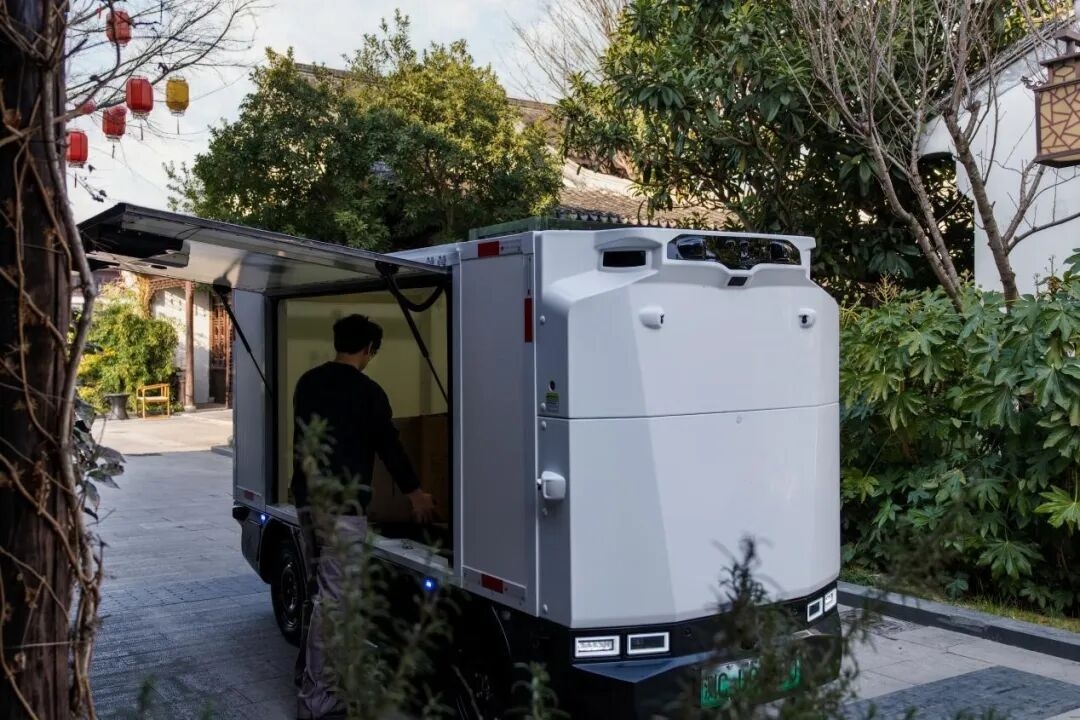
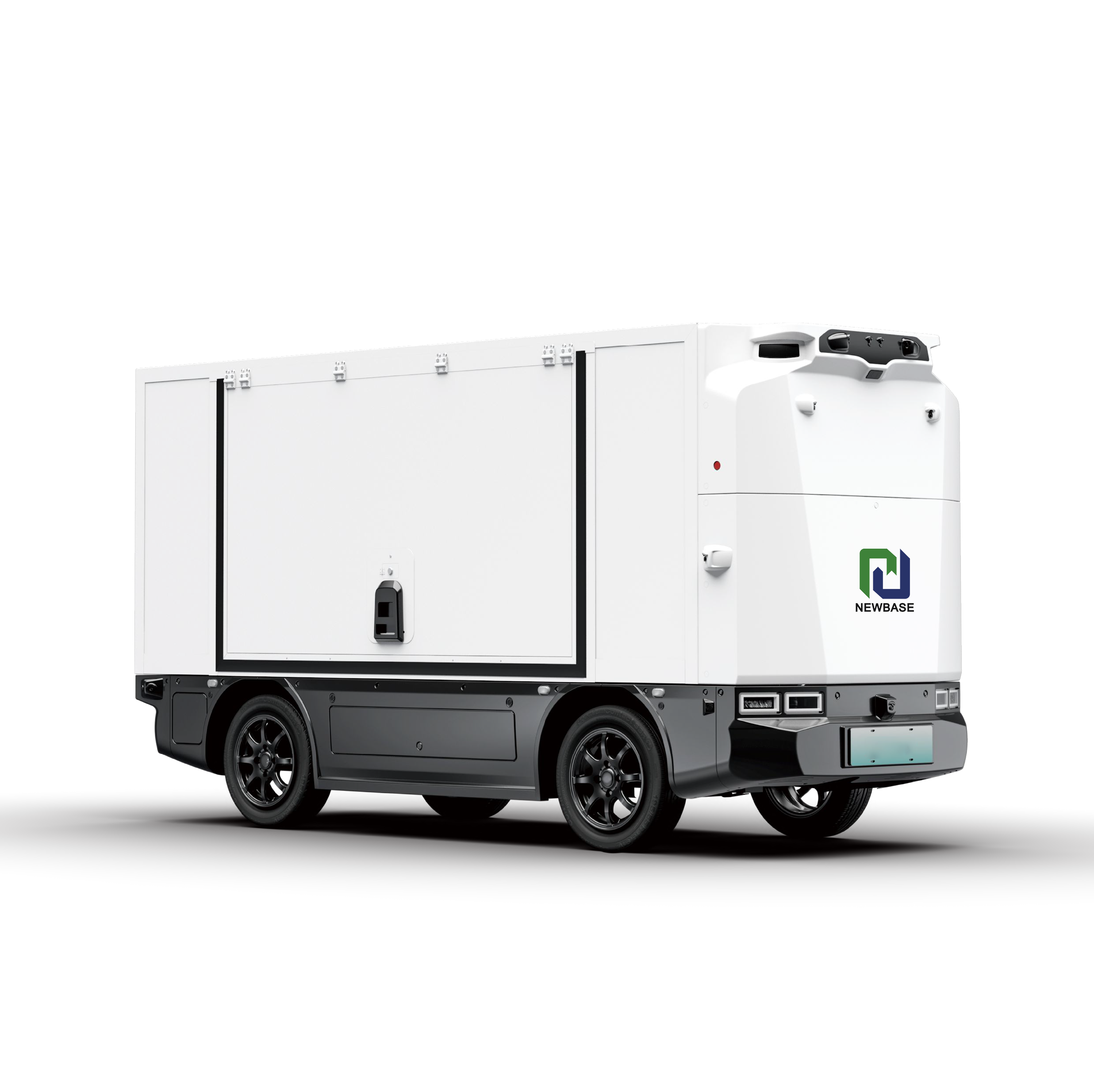
A forklift compatible autonomous delivery van for warehouse operations cuts loading/unloading time by 40–60% and eliminates the #1 bottleneck in yard logistics — manual dock scheduling and manual pallet movement. Unlike standard autonomous delivery vehicles that require manual hand-loading or conveyor integration, a purpose-built forklift compatible autonomous delivery van for warehouse fleets accepts standard pallets directly via forklift from the side or rear, making it drop-in compatible with every warehouse's existing material-handling equipment. For 3PLs, manufacturing plants, and distribution centers running 2–3 shift operations, this single design decision determines whether an autonomous van delivers a real ROI in 12 months or becomes a niche curiosity. NewBase offers one of the few production-grade models on the market engineered from the ground up for forklift and pallet-jack loading, with cargo volumes from 2 m³ to 10 m³ and support for both indoor and outdoor yard operations.
Why Forklift Compatibility Defines Warehouse ROI
Most autonomous delivery vehicles on the market are designed for last-mile urban delivery — they have rear-loading doors, small cargo bays, and no structural reinforcement for forklift loads. When warehouse operators try to repurpose them for yard or cross-dock moves, they run into three hard problems.
First, loading a standard 1,000 kg pallet by hand or with a manual pallet jack through a rear door takes 8–12 minutes per stop, and requires a worker on each end. At 20 stops per shift, that is 3–4 labor-hours wasted just on load transfer — exactly the cost the autonomous van was supposed to eliminate.
Second, the cargo floor and frame of a typical delivery van are not engineered for the repeated impact of a 2,000 kg forklift with a raised pallet. After 3–6 months of daily use, floor panels bend, door frames warp, and the vehicle is out of service for repairs.
Third, most warehouse yards operate on a tight dock schedule. If an autonomous van cannot be loaded at a dock door or from the side by a forklift that is already moving other pallets, it has to wait in a queue — defeating the whole purpose of on-demand autonomous logistics.
A purpose-built autonomous van with forklift loading for warehouse logistics solves all three by design: reinforced cargo floors, side and rear access doors sized for standard pallets, and a chassis height matched to standard forklift and pallet-jack working heights.
| Feature | Standard Delivery AV | Forklift-Compatible Warehouse AV |
| Cargo access | Rear door only | Rear + side (1–2 side doors) |
| Floor load rating | 300–500 kg distributed | 1,000–1,500 kg per pallet position |
| Pallet compatible | No (loose parcels only) | Yes (standard EUR/US pallet sizes) |
| Loading method | Manual / conveyor | Forklift / pallet jack / manual |
| Typical load time per pallet | 8–12 min (hand-load) | 60–90 sec (forklift) |
| Indoor + outdoor yard | Usually outdoor only | Both, with floor-level entry |
| NewBase Z8Max | — | Side + rear three-door, 10 m³, pallet-ready |
The arithmetic is straightforward. If a warehouse currently uses a human-driven yard truck and a forklift driver to move 40 pallets per day between the warehouse and a nearby production building, switching to a warehouse yard autonomous vehicle forklift compatible model eliminates the yard-truck driver entirely and reduces the forklift driver's load-handling time from ~6 hours to ~1.5 hours per day. At fully-loaded labor costs of US$18–25/hour in North America and €15–22/hour in Western Europe, that is US$30,000–50,000 per year in direct labor savings — per vehicle.
NewBase, whose full official name is Zhengzhou Newbase Auto Electronics Co., Ltd., designs its Z-series autonomous logistics vehicles with a modular cargo-box architecture that allows customers to spec side-door count, floor reinforcement, and pallet-guide rails during the ordering process. This means each unit is tuned to the exact warehouse workflow it will serve, rather than forcing the warehouse to adapt to a generic vehicle.
✅ Bottom line: Forklift compatibility is not a "nice-to-have" for warehouse autonomous vans — it is the single feature that determines whether the vehicle integrates into existing operations or creates a new manual-work bottleneck. Expect 40–60% faster load cycles and direct labor savings of US$30k–50k/year per vehicle when the forklift interface is done right.
How to Spec and Deploy a Forklift-Compatible Autonomous Van
Buying the right vehicle requires matching three sets of parameters: the physical warehouse environment, the cargo profile, and the operational model. Getting any one of them wrong means the van either cannot do the job or does it at a fraction of its potential throughput.
1. Environment: Indoor, Outdoor Yard, or Both
Warehouse use cases fall into three categories, and each favors a different vehicle class.
- Pure indoor warehouse (aisle-to-aisle, floor-level): Low-speed (5–10 km/h), compact footprint, SLAM-based indoor navigation, and floor-level cargo access for pallet jacks. Cargo volume is typically 2–4 m³.
- Outdoor yard only (dock-to-dock, building-to-building): Higher speed (15–30 km/h), weather-sealed, GPS + LiDAR outdoor navigation, and dock-height or ground-level loading depending on the site. Cargo volume is typically 6–15 m³.
- Hybrid indoor + outdoor (yard + warehouse interior): The most demanding spec, requiring both indoor SLAM and outdoor localization, weather sealing on one side and clean-floor design on the other. NewBase's Z-series platform supports this hybrid mode because the same drive-by-wire chassis and sensor suite work in both environments, with only the cargo-box configuration changing.
2. Cargo Profile: Pallet Size, Weight, and Volume
The three numbers that drive vehicle sizing are pallet footprint (EUR-pallet 800×1200 mm, US-pallet 1016×1219 mm), maximum pallet weight (typically 800–1,200 kg for mixed warehouse goods), and how many pallets must move per trip.
| Pallets per trip | Minimum cargo volume | Typical vehicle class | Example model |
| 1 pallet | ~1.5–2 m³ | Compact indoor AV | NewBase Z5 Box |
| 2–3 pallets | ~5–7 m³ | Mid-size yard AV | NewBase Z8 |
The forklift compatible autonomous delivery van for warehouse deployment with the fastest payback is almost always the one that matches the existing pallet flow — not the one with the biggest cargo box or the longest range. If a warehouse moves mostly single pallets on demand, a 2 m³ compact unit running 24/7 beats a 10 m³ unit waiting to fill up every time.
3. Operational Model: Scheduled Routes vs On-Demand
There are two dominant warehouse operating models for autonomous yard vehicles:
- Scheduled fixed routes (milk runs): The van follows a timed loop between dock doors, picking up and dropping off pallets on a fixed schedule. Best for predictable, high-volume flows between two or three buildings. Easy to plan, easy to measure.
- On-demand dispatch: The van is called via a warehouse management system (WMS) integration or a simple tablet app, similar to an internal taxi service. Best for variable-demand environments — 3PLs, e-commerce fulfillment centers, and multi-tenant industrial parks. NewBase's fleet management platform supports both modes out of the box, with WMS API integration for on-demand dispatching.
One deployment tip that experienced warehouse teams always mention: start with a single fixed route that has clear, measurable KPIs (pallets moved per day, labor hours saved, on-time delivery rate), prove the ROI in 60–90 days, then expand to on-demand and additional routes. This de-risks the project and builds internal buy-in before a larger fleet commitment.
✅ Bottom line: The right spec depends on environment (indoor/outdoor/hybrid), cargo profile (pallet count, weight, volume), and operational model (scheduled vs on-demand). Start with one proven route and expand from there — the fastest ROI comes from matching the vehicle to an existing pallet flow, not from over-spec'ing the hardware.
FAQ
Q: Can any autonomous delivery van be used with a forklift, or does it need special design?
It needs a purpose-built design. Three things make a van truly forklift-compatible: a reinforced cargo floor rated for concentrated pallet loads (not just distributed parcel weight), door openings sized for standard pallets, and a chassis height that matches standard forklift and pallet-jack working heights. A standard last-mile delivery van will fail structurally within months if used for forklift loading, and the load/unload cycle will be too slow to be useful.
Q: How does a warehouse yard autonomous vehicle forklift compatible model navigate without a driver?
It uses a combination of LiDAR, cameras, and (for outdoor yards) GPS-RTK localization, with SLAM mapping for indoor warehouse environments. The vehicle is mapped to the site once during a 1–3 day commissioning process, then follows planned routes and detects obstacles (pedestrians, other forklifts, pallets left in aisles) in real time. Safety-rated speed limits and stop zones are configured per site.
Q: What is the typical payback period for an autonomous van with forklift loading for warehouse logistics?
For a single-shift warehouse operation, payback is typically 18–24 months when the vehicle replaces a dedicated human-driven yard truck or reduces a forklift operator's load-handling time by 3+ hours per day. For two- or three-shift operations — where the autonomous van runs 16–20 hours a day — payback drops to 10–14 months because the same fixed hardware cost is spread across more productive hours.
Ready to Spec Your Forklift-Compatible Autonomous Fleet?