Campus security has entered a new era. The traditional model of security guards walking fixed routes with flashlights and radios, supplemented by fixed CCTV cameras, is no longer sufficient for protecting modern campuses. Universities, corporate parks, industrial facilities, and government complexes now span hundreds of acres with diverse security challenges that demand continuous, comprehensive surveillance.
The autonomous security patrol vehicle with integrated drone surveillance system represents the next evolution in campus security technology, combining ground-based autonomous patrol with aerial drone support to create a layered, 24/7 security presence that human guards alone cannot achieve.
This guide examines the technology, applications, deployment considerations, and return on investment for ground-air integrated autonomous security systems, with specific focus on the North American market where campus security requirements are particularly rigorous.
The Limitations of Traditional Campus Security
Understanding why autonomous patrol systems are gaining traction requires an honest assessment of traditional security approaches:
Human Guard Limitations
- Physical fatigue limits patrol effectiveness, particularly during night shifts and in extreme weather conditions
- Guards can only be in one location at a time, leaving large areas unmonitored during patrol transitions
- Consistency varies between individual guards and across shifts
- Labor costs for 24/7 security coverage are substantial: a 500-acre campus typically requires 8 to 12 guards per shift, three shifts per day
- High turnover rates in security staffing (industry average 50 to 100 percent annually) create training gaps and inconsistency
Fixed Camera Limitations
- CCTV cameras provide point surveillance but cannot follow suspicious activity across a campus
- Blind spots exist between camera positions, particularly in parking structures, building perimeters, and wooded areas
- Camera systems require ongoing maintenance and may be disabled by weather, vandalism, or technical failures
- Video monitoring of large camera networks is labor-intensive and prone to alert fatigue among monitoring staff
The combination of these limitations creates security gaps that autonomous patrol vehicles are specifically designed to address.
Ground-Air Integrated Security: How It Works
The most advanced autonomous security patrol systems combine two platforms operating in coordination:
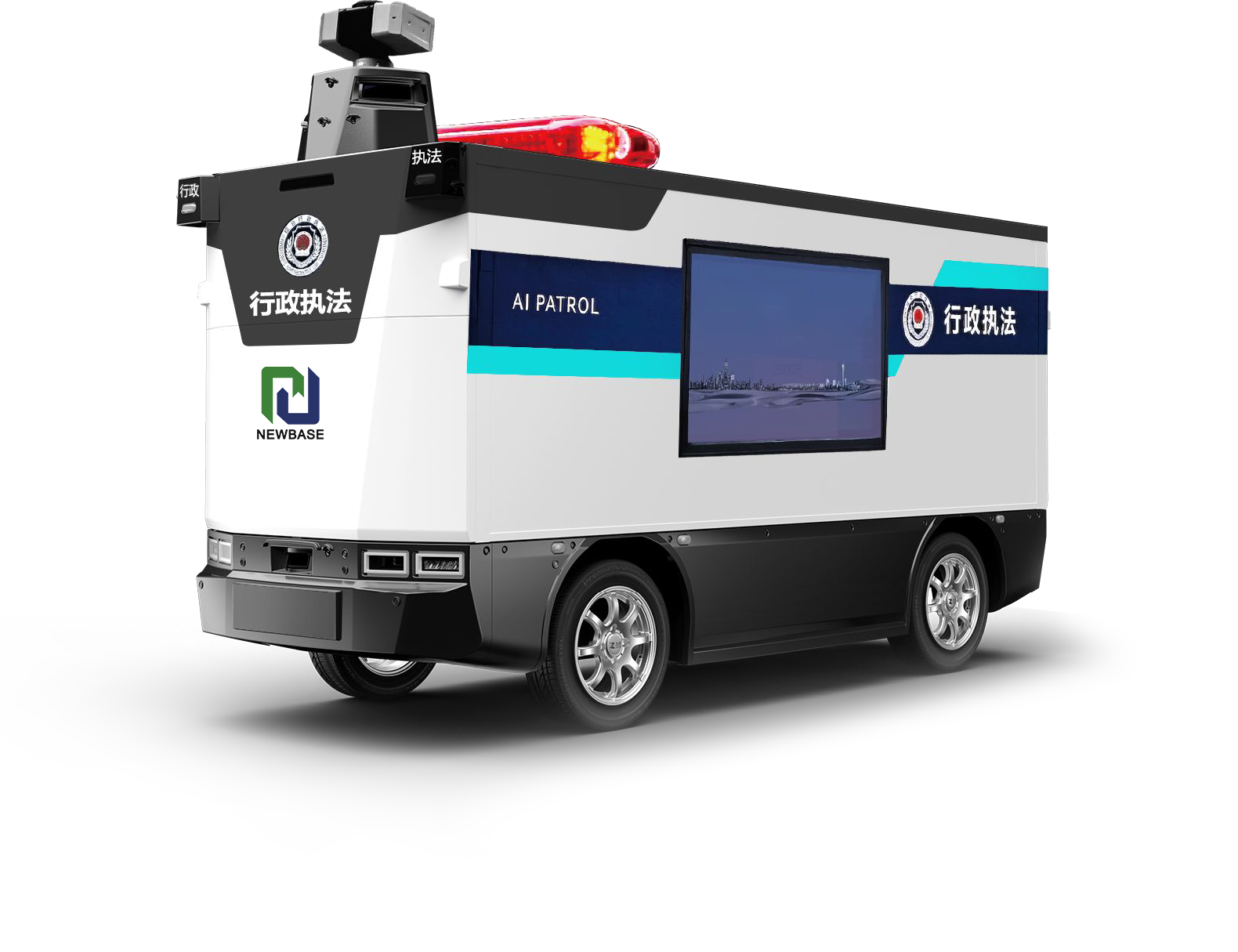
The L4 driverless patrol car for campus and industrial facility security operates as a mobile security node that traverses predefined patrol routes autonomously. Key capabilities include:
- Autonomous navigation along programmed routes with GPS and HD map positioning
- 360-degree perception using LiDAR, cameras, and radar for obstacle detection and navigation safety
- High-resolution camera system with PTZ (Pan-Tilt-Zoom) capability for detailed area surveillance
- Thermal imaging camera for night operations and detection of heat anomalies (fires, overheating equipment, hidden individuals)
- Two-way audio system for remote communication with people on campus
- Emergency lighting and siren for incident response
- Environmental sensors (air quality, temperature, humidity) for facility monitoring
Air Platform: Integrated Drone System
The ground-air integrated security vehicle with AI PTZ camera specifications includes an onboard drone system that extends surveillance capability vertically:
- Vertical takeoff and landing (VTOL) drone deployed from the patrol vehicle roof or integrated bay
- Drone flight range of 2 to 5 km from the patrol vehicle
- High-resolution camera with zoom capability for aerial inspection of areas inaccessible to ground vehicles
- Thermal imaging for aerial heat detection
- Autonomous flight patterns programmed to complement ground patrol routes
- Automatic return-to-vehicle for recharging
Coordination Between Ground and Air
The key innovation is not the individual platforms but their coordinated operation:
- When the ground patrol vehicle detects suspicious activity, the drone launches to provide aerial overview while the ground vehicle approaches
- The drone can inspect rooftops, parking structures, and wooded areas while the ground vehicle covers building perimeters
- Both platforms transmit video to a unified monitoring dashboard, giving security operators a comprehensive view
- AI algorithms correlate data from both platforms to identify threats that neither could detect alone
- The drone can be dispatched to investigate alarms (door sensors, motion detectors) while the ground patrol vehicle continues its route
Applications Across Campus Types
University and College Campuses
University campuses present diverse security challenges: dormitory areas requiring privacy-respecting surveillance, parking lots vulnerable to vehicle theft, athletic facilities with after-hours trespassing, and large open spaces where traditional cameras are ineffective.
- Night patrol of parking lots and peripheral areas without disturbing sleeping students
- Rapid response to security alarms at any campus location
- Event-day security augmentation for athletic events and concerts
- Drone inspection of campus perimeter fencing and gates
- Environmental monitoring for fire detection in wooded campus areas
Government and Research Facilities
High-security government and research campuses require:
- Persistent perimeter surveillance with immediate intrusion response
- Background-checked access point monitoring
- Drone-based inspection of restricted areas without exposing personnel to potential threats
- Continuous environmental monitoring for chemical or biological hazards
- Evidence-grade video recording for incident investigation
Key Technical Specifications
Ground Patrol Vehicle Specifications
For effective campus security, the patrol vehicle should meet these specifications:
- Operating speed: 5 to 25 km/h (patrol speed adjustable based on environment)
- Operating range: 12 to 24 hours per charge, or 80 to 150 km per charge
- Obstacle detection range: minimum 30 meters in all directions
- Camera resolution: 4K minimum for visible light, 640x480 minimum for thermal
- PTZ camera range: 20x optical zoom minimum
- Audio: 100-meter effective range for two-way communication
- Lighting: 360-degree LED lighting with minimum 50-meter illumination range
- Weather resistance: IP67 rated for all-weather operation
- Operating temperature: minus 20 to plus 55 degrees Celsius
- Emergency battery backup: minimum 2 hours for continued operation during charging system failure
Integrated Drone Specifications
- Flight time: 30 to 60 minutes per charge
- Camera resolution: 4K visible light with 30x zoom, thermal imaging 640x512
- Maximum flight speed: 60 km/h for rapid response
- Operating range: 2 to 5 km from patrol vehicle
- Wind resistance: stable operation in winds up to 25 km/h
- Rain resistance: light rain operation capability
- Autonomous flight capability: pre-programmed patterns and patrol sequences
AI and Analytics Specifications
- Person detection accuracy: 99 percent plus at 200 meters in daylight, 100 meters at night (thermal)
- Vehicle detection and license plate recognition: 95 percent plus at 50 meters
- Behavior anomaly detection: identification of loitering, running, climbing, and other suspicious behaviors
- Fire and smoke detection: alarm generation within 30 seconds of visual detection
- Integration with existing security systems: ONVIF-compatible camera integration, alarm panel connectivity, access control system integration
Deployment Planning
Site Assessment
Before deploying an autonomous patrol system, conduct a thorough site assessment:
- Map patrol routes identifying high-priority areas (perimeters, parking lots, building entrances, restricted zones)
- Identify areas where drone surveillance provides unique value (rooftops, wooded areas, open fields)
- Assess network connectivity coverage across the patrol area (4G/5G cellular or Wi-Fi mesh)
- Identify charging station locations with power access and weather protection
- Map existing security infrastructure (cameras, access control, alarm systems) for integration planning
- Identify potential GPS-denied areas (indoor parking structures, dense building corridors) that may require supplemental navigation technology
The ROI for an autonomous security patrol system depends on the cost it replaces and the additional security capability it provides.
Cost Reduction
For a 500-acre campus currently employing 10 security guards per shift across three shifts (30 guards total):
- Annual guard labor cost: 30 guards x 45,000 USD = 1,350,000 USD per year
- With autonomous patrol covering night shifts and low-activity periods, guard requirements may be reduced to 15 to 20 guards focused on high-value tasks (access control, incident response, visitor management)
- Annual labor savings: 450,000 to 675,000 USD
Capital Investment for Autonomous Patrol System:
- 2 to 4 autonomous patrol vehicles with integrated drone systems: 400,000 to 800,000 USD
- Charging infrastructure (4 to 8 stations): 40,000 to 80,000 USD
- Fleet management platform and monitoring center integration: 50,000 to 150,000 USD
- Annual maintenance and connectivity: 30,000 to 60,000 USD per year
ROI Calculation:
- Annual savings: 450,000 to 675,000 USD
- Annual operating costs: 30,000 to 60,000 USD
- Net annual benefit: 390,000 to 615,000 USD
- Capital payback period: 1.3 to 2.1 years
Beyond direct cost savings, autonomous patrol provides security value that is difficult to quantify:
- Elimination of security gaps during shift changes and break periods
- Consistent, unflagging patrol quality regardless of time or weather
- Immediate response to alarms anywhere on campus
- Aerial surveillance capability that human guards cannot provide
- Comprehensive documentation of all patrol activity for incident investigation and liability protection
NEWBASE Z5 Integrated Security Patrol Vehicle
NEWBASE's Z5 Integrated Security Patrol Vehicle is a purpose-built L4 autonomous security platform designed for campus and industrial facility applications:
- L4 fully autonomous operation with programmable patrol routes
- Integrated drone system with AI PTZ camera for ground-air coordinated surveillance
- 360-degree perception system (LiDAR + cameras + radar)
- Thermal imaging for day/night operation in all weather conditions
- Two-way audio communication for remote interaction
- Emergency lighting and siren system
- IoT connectivity with fleet management and monitoring platform
- 12 to 24 hours operating time per charge
- IP67 rated for all-weather operation
- Designed for North American market with CE and emerging US certifications
The Z5 platform is manufactured under IATF 16949 quality standards, ensuring consistent performance and reliability for security-critical applications.
Conclusion
The autonomous security patrol vehicle with integrated drone surveillance represents a transformative advancement in campus security capability. By combining ground-based autonomous patrol with aerial drone support, these systems provide comprehensive, persistent surveillance that addresses the fundamental limitations of traditional security approaches.
For campus security directors and facility managers in North America, the combination of substantial labor cost savings, enhanced security coverage, and consistent operational performance creates a compelling ROI that justifies investment in autonomous patrol technology.
As the technology continues to mature and regulatory frameworks for autonomous vehicles on private property become more established, ground-air integrated security systems will become the standard for campus protection across education, corporate, industrial, and government sectors.
Contact NEWBASE to discuss your campus security requirements and receive a customized deployment proposal including vehicle specifications, fleet sizing, and ROI projections for your specific facility.