Southeast Asia's tourism industry generates over 400 billion USD in annual revenue, supporting hundreds of millions of visitors who travel to the region's resorts, theme parks, airports, and cultural sites. Moving these visitors efficiently, safely, and memorably within large resort complexes and between airport terminals and parking areas has become a significant operational challenge and a competitive differentiator.
The L4 driverless sightseeing vehicle for resort and airport shuttle service is emerging as a transformative solution for Southeast Asian tourism operators. By eliminating driver labor costs while providing a novel, memorable guest experience, autonomous shuttles address both operational economics and guest satisfaction simultaneously.
This article examines the market dynamics, technical requirements, economic model, and deployment considerations for autonomous sightseeing vehicles in Southeast Asia's tourism sector.
The Southeast Asia Tourism Mobility Challenge
Southeast Asia's tourism infrastructure faces unique mobility challenges that make autonomous shuttles particularly well-suited:
Airport Ground Transportation
Airports in Southeast Asia are experiencing rapid growth, with passenger volumes increasing 8 to 12 percent annually in major hubs like Singapore Changi, Bangkok Suvarnabhumi, Kuala Lumpur International, and Manila Ninoy Aquino.
Moving passengers between terminals, parking areas, rental car facilities, and ground transportation hubs requires shuttle fleets that operate continuously. The cost-effective driverless tourism vehicle for closed campus operations offers airports a way to scale shuttle capacity without proportionally scaling driver staffing.
Closed-Campus Advantages
One of the most significant factors favoring autonomous vehicle deployment in Southeast Asia's tourism sector is the prevalence of closed-campus environments. Resorts, theme parks, golf courses, and airport facilities are privately controlled environments with:
- Well-maintained roads and predictable traffic patterns
- Controlled access points that limit interaction with public road traffic
- Established speed limits (typically 15 to 25 km/h)
- Minimal regulatory barriers compared to public road autonomous vehicle deployment
- Dedicated shuttle routes with fixed paths
These closed environments dramatically simplify the technical requirements for autonomous operation compared to public road deployment, making L4 autonomous shuttles viable with current technology.
Market Opportunities by Country
Thailand
Thailand receives over 40 million international visitors annually, with Phuket, Koh Samui, and Pattaya featuring large resort complexes that are ideal for autonomous shuttle deployment. The Thai government has expressed support for smart tourism infrastructure, and several pilot programs are already underway.
Indonesia
Indonesia's Bali alone receives over 7 million international visitors annually, with Nusa Dua resort complex and Jimbaran area featuring extensive properties where autonomous shuttles could significantly reduce shuttle operating costs. The Indonesian government's tourism development plans include smart infrastructure investments.
Philippines
The Philippines' resort island destinations (Boracay, Palawan, Cebu) feature compact resort zones where autonomous shuttles can provide efficient guest transportation. The country's growing focus on tourism infrastructure modernization aligns with autonomous mobility adoption.
Vietnam
Vietnam's rapidly growing tourism sector includes large resort developments in Da Nang, Nha Trang, and Phu Quoc. New resort developments can integrate autonomous shuttle infrastructure from the planning stage, optimizing route design and charging station placement.
Malaysia
Malaysia's integrated resort complexes (including Genting Highlands and Langkawi developments) and airport facilities provide ideal closed-campus environments for autonomous shuttle deployment.
Technical Requirements for Resort Autonomous Shuttles
Vehicle Design for Tourism Applications
The autonomous electric shuttle bus for Southeast Asia tourism industry must be designed specifically for guest comfort and safety:
Passenger Capacity: 8 to 14 passengers per vehicle, with seating designed for a resort shuttle experience (open or semi-open configurations for sightseeing, enclosed configurations for all-weather operation)
Accessibility: Low-floor or ramp-access design for wheelchair users, elderly guests, and guests with luggage
Climate Control: Air conditioning with sufficient capacity for tropical conditions (32 to 38 degrees Celsius with high humidity)
Luggage Storage: Designated luggage areas that do not obstruct passenger seating or exits
Visibility: Large windows and open-air sections for sightseeing enjoyment
Audio System: On-board commentary capability for resort information and promotional content
Autonomous System Requirements
Operating Environment: Closed campus with well-maintained roads, controlled access, and predictable traffic
Speed Range: 5 to 25 km/h (sufficient for resort and airport shuttle operations)
Sensor Suite: 360-degree LiDAR coverage, multi-camera system, radar for all-weather operation
Navigation: HD map-based positioning with GPS correction for precise route following
Obstacle Detection: Real-time detection of pedestrians, vehicles, animals (important in tropical resort environments), and obstacles with minimum 30-meter detection range
Emergency Response: Automatic emergency braking with response time under 200 milliseconds, manual override capability via remote monitoring
Passenger Safety: Seat belts, emergency exits, fire suppression system, and crash-optimized vehicle structure
Tropical Environment Engineering
Southeast Asia's tropical climate creates specific engineering challenges:
- High humidity (70 to 95 percent) accelerates corrosion and can affect electronic components
- Heavy rainfall during monsoon seasons requires all-weather navigation capability
- Tropical sun exposure (UV index 10 to 12) causes rapid material degradation
- High ambient temperatures reduce battery efficiency and increase cooling system load
Vehicles deployed in Southeast Asian resort environments must feature:
- IP67-rated electrical and electronic components
- Marine-grade corrosion-resistant materials
- Sealed bearing systems and rustproof fasteners
- UV-stabilized exterior panels and window materials
- Enhanced cooling systems for batteries and electronic components
- Tropical-optimized air conditioning systems
- Rain-rated sensors and cameras with automatic cleaning systems
Economic Analysis: Autonomous vs Traditional Shuttle Operations
Cost Model for Traditional Resort Shuttle
For a mid-size resort complex requiring continuous shuttle service on a 5 km internal route:
- 4 shuttle vehicles (ensuring continuous coverage with rotation for charging and maintenance)
- 12 drivers (3 per vehicle across 3 shifts: 6 AM to 2 PM, 2 PM to 10 PM, 10 PM to 6 AM)
- Driver monthly cost in Southeast Asia: 500 to 800 USD per month (varies by country)
- Annual driver cost: 12 drivers x 600 USD x 12 months = 86,400 USD
- Vehicle acquisition (4 diesel or electric shuttle carts): 40,000 to 80,000 USD
- Annual vehicle operating costs (fuel/electricity, maintenance): 8,000 to 16,000 USD per vehicle x 4 = 32,000 to 64,000 USD
- Total annual operating cost: 118,400 to 150,400 USD
- Cost per shuttle trip (estimated 30 trips per day per vehicle, 4 vehicles, 365 days = 43,800 trips per year): 2.70 to 3.43 USD per trip
Cost Model for Autonomous Resort Shuttle
- 4 autonomous shuttle vehicles: 150,000 to 250,000 USD (higher unit cost but no drivers)
- 1 to 2 remote monitoring operators overseeing all vehicles: 12,000 to 19,200 USD per year
- Vehicle operating costs (electricity, sensor maintenance): 4,000 to 8,000 USD per vehicle x 4 = 16,000 to 32,000 USD
- Total annual operating cost: 28,000 to 51,200 USD
- Cost per trip: 0.64 to 1.17 USD per trip
- Cost reduction vs traditional: 57 to 76 percent per trip
ROI Calculation:
- Annual savings: 67,200 to 122,400 USD
- Additional capital cost (autonomous premium): 110,000 to 210,000 USD
- Payback period: 1.8 to 3.1 years
- Five-year net savings: 126,000 to 402,000 USD
Beyond the direct financial savings, autonomous shuttles provide intangible benefits that influence resort revenue:
- Novel guest experience: Autonomous shuttles generate guest interest, social media content, and positive reviews that enhance resort brand perception
- Consistent service quality: No variation between drivers (driving style, route knowledge, guest interaction)
- Extended operating hours: Autonomous shuttles can operate during early morning and late evening periods that are difficult to staff with human drivers
- Multilingual capability: On-board audio systems can provide commentary in multiple languages simultaneously, unlike human drivers
Gradual Introduction
Recommended approach:
- Week 1-2: Demonstration mode with safety operator present, limited hours, guest feedback collection
- Week 3-4: Extended hours without safety operator, staff available at major stops
- Month 2-3: Full autonomous operation with remote monitoring only
- Month 4+: Continuous operation with ongoing optimization based on performance data
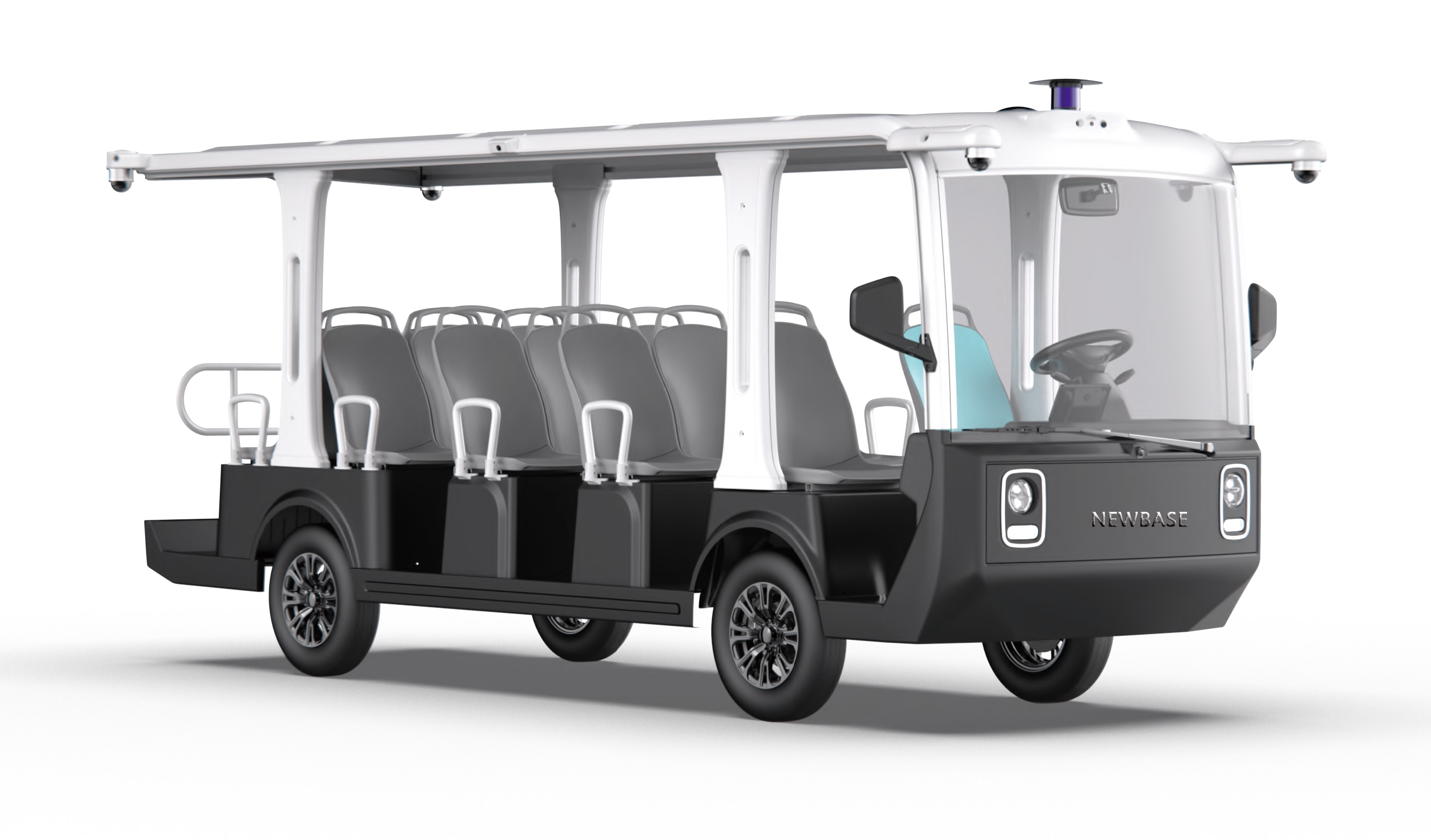
NEWBASE's Yokee autonomous sightseeing vehicle is designed specifically for resort and tourism applications in Southeast Asia and global markets:
- L4 fully autonomous operation in closed-campus environments
- 8 to 14 passenger capacity in multiple seating configurations
- Tropical-optimized engineering with IP67 protection and corrosion-resistant construction
- 360-degree sensor suite (LiDAR + cameras + radar) for all-weather operation
- Open-air and enclosed configuration options for different resort aesthetics and climates
- On-board audio commentary system with multilingual capability
- Low-floor design with wheelchair ramp access
- Electric powertrain with 80 to 120 km operating range per charge
- IoT fleet management platform with real-time monitoring
- Automatic docking charging system for unattended operation
- Emergency stop buttons at every passenger seat
Manufactured under IATF 16949 quality standards with a monthly production capacity of 10,000 units, NEWBASE can support resort shuttle fleet deployments of any size across Southeast Asia.
Conclusion
Southeast Asia's tourism industry is perfectly positioned to benefit from autonomous sightseeing vehicle technology. The combination of large closed-campus resort environments, growing tourism volumes, and the economic advantages of driverless operation creates an ideal market for L4 autonomous shuttles.
For resort operators, airport managers, and tourism facility managers in Southeast Asia, the autonomous sightseeing vehicle offers a rare combination of cost reduction and guest experience enhancement. The driverless tourism vehicle for closed campus operations is not just a cost-saving tool - it is a competitive differentiator that positions forward-thinking tourism operators as technology leaders in an increasingly experience-driven market.
As autonomous vehicle technology continues to mature and costs decrease, the economic advantage of autonomous shuttles will only grow, making early adoption a strategic investment in future competitiveness.
Contact NEWBASE to discuss your resort or tourism facility shuttle requirements and receive a customized deployment proposal for Southeast Asian operations.